The future of abortion access depends on
more funding and the Infrastructure
to make it go further than ever before.
Meet SHARE Equity and Autonomie
The Unassailable
Truth.
Every person deserves the freedom to make decisions about their own body, their own future, and their own family.
The evidence is clear. The landmark Turnaway Study demonstrates that access to abortion changes the trajectory of a person's life. People who receive the abortion they seek are more likely to maintain economic stability and pursue their educational and career goals.
Bodily autonomy is more than a healthcare issue. It is an issue of economic justice, racial justice, gender equity, and human dignity.
The majority of abortion seekers are low-income BIPOC.
Below 200% FPL
Seventy-one percent of abortion patients live at or below 200 percent of the federal poverty level.
People of Color
Sixty-one percent of abortion patients are people of color.
Already Parents
Nearly sixty percent are already raising children.
These families are forced to choose between paying their rent, feeding their children, and keeping their jobs or traveling hundreds/thousands of miles away to obtain this essential healthcare.
The movement's challenge has fundamentally changed. Winning legal rights is no longer enough. The next generation must build the infrastructure that allows people to exercise those rights for generations to come.
A right that exists only on paper is not enough.
Abortion is still legal in (most of) the United States, but only half of abortion seekers can afford it, and the current restrictions make it even more challenging for people to access.
Timeline
From Legal Rights to an Infrastructure Crisis
Fifty Years of Racial Justice and Feminist Progress Under Attack.
A Half-Century of Eroding Access.
1973
Roe v. Wade
Abortion becomes a constitutional right.
1976
Hyde Amendment
Financial barriers begin.
1980s–2021
Restrictions Expand
Funding cuts, clinic closures, and state restrictions steadily erode access.
2022
Dobbs
Constitutional protections are overturned.
Today
Infrastructure Era
Access now depends on coordinated providers, funding, travel, and support.
1973
Roe v. Wade
Abortion becomes a constitutional right.
1976
Hyde Amendment
Financial barriers begin.
1980s–2021
Restrictions Expand
Funding cuts, clinic closures, and state restrictions steadily erode access.
2022
Dobbs
Constitutional protections are overturned.
Today
Infrastructure Era
Access now depends on coordinated providers, funding, travel, and support.
Over five decades, the challenge shifted from protecting a legal right to building the infrastructure that makes that right accessible.
A Half-Century Strategy
Dobbs did not create the crisis.It completed a strategy that had been unfolding for half a century.
Legal rights no longer guarantee access. Access now depends on whether patients can navigate a fragmented, under-resourced system.
The Infrastructure Era
In response to relentless political attacks, the reproductive justice movement built abortion funds, practical support organizations, legal defense networks, and community partnerships to ensure patients could access care.
While this created one of the world's most resilient abortion access ecosystems, decades of crisis response left little opportunity to build the shared infrastructure needed to connect it. Instead of investing in interoperable technology, coordinated patient navigation, and permanent financial systems, the movement was forced to focus on meeting each new challenge as it emerged.
This fragmentation is a direct consequence of asking hundreds of organizations to solve a national healthcare challenge without investing in the systems every other sector of healthcare takes for granted.
Without coordinated systems, bodily autonomy exists only on paper.
The Patient's Journey
Today's Reality
A single successful abortion typically requires twelve coordinated steps across as many independent organizations. Watch one patient's path.
Patient
Patient approaches provider
at Provider
- 01Patient approaches provider
- 02Eligibility evaluation
- 03Financial need flagged
- 04Internal funds checked
- 05NAF hotline & intake
- 06Regional fund & intake
- 07Practical support & intake
- 08Specialized fund if needed
- 09Back to provider to confirm pledges
- 10Telehealth or in-person logistics
- 111–3 days of visits by gestation
- 12Return travel & aftercare
Patients don't experience one healthcare system. They navigate dozens of disconnected organizations, each with its own intake, eligibility rules, and coordination process.
This fragmentation is not an organizational failure; it is a direct consequence of a calculated campaign to isolate abortion care.
Reproductive justice requires extraordinary coordination — not because organizations aren't working together heroically, but because the infrastructure to make connection easier and in support of this great work just does not exist.
Introducing

An institution built
to build the infrastructure.
SHARE Equity builds the shared financial and operational systems that make abortion care more equitable, sustainable, and resilient.
Through pilot projects with Planned Parenthood Federation of America, PP affiliates, independent providers, abortion funders, practical support organizations, and reproductive justice leaders, SHARE Equity has now rolled out the operational and financial infrastructure for a post-Dobbs future that reflects the needs of the full abortion access eco-system today and in the future. All we need now is the support of private philanthropists to make it a permanent solution.

SHARE Equity Founder & Executive Director
Morgan Love
Morgan Love is building the infrastructure necessary to connect all of the stakeholders and center the patient experience. A digital health strategist, healthcare advocate, and leader in the reproductive justice movement, Morgan is best known for combining technology infrastructure with grassroots advocacy to expand abortion access and advance health equity.
Her work centers on rebuilding reproductive health infrastructure through a digital-first lens. Morgan and SHARE Equity focus on bypassing traditional bureaucratic bottlenecks in healthcare to get mutual aid and funding directly into the hands of those who need it most, with a particular emphasis on diversity, equity, and inclusion within the healthcare landscape.
Now — SHARE Equity, an organization founded in 2019, has created the solution and is working with PPFA, independent clinics and other providers and funders across the country.
The Plan
Together, we will.
The abortion access ecosystem needs the same infrastructure every mature healthcare system eventually builds.
1. Build the Infrastructure
The Shared Operating System for Abortion Access
It is the operational foundation for a coordinated national access ecosystem — Autonomie transforms this fragmented experience into one coordinated patient journey.
Our Vision
Our vision is to establish the shared operational infrastructure that makes the gold standard of abortion care possible.
Meet Autonomie
Autonomie is the shared care coordination infrastructure that connects patients, providers, navigators, and funders to ensure that all vested partners have access and sight into the full ecosystem while addressing administrative and technological barriers we know providers and clinics face every day.
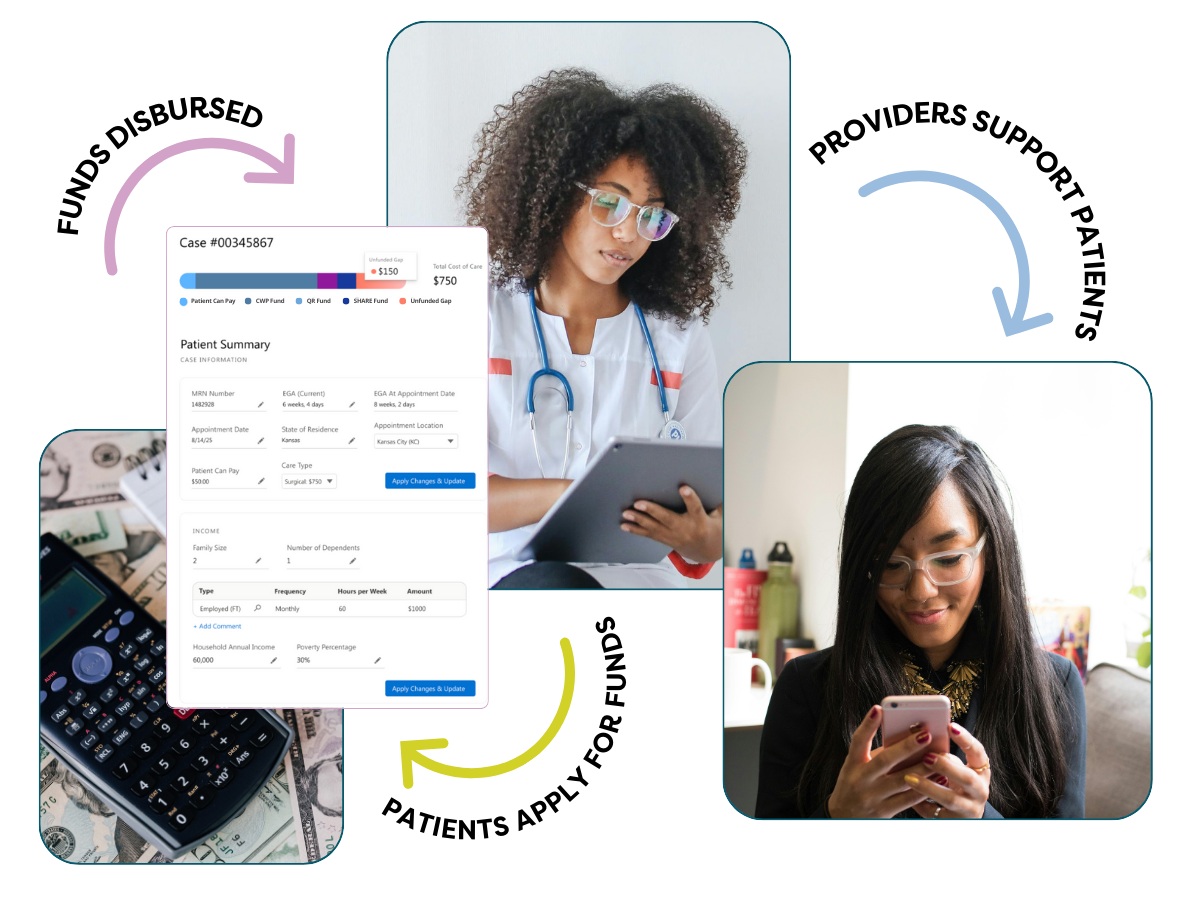
What Autonomie Does
Autonomie transforms a fragmented experience into one coordinated patient journey.
Automated Eligibility Determination
Instantly qualifies patients for the funding and services they need — no manual paperwork loops.
Intelligent Patient Routing
Matches each patient with the right provider, fund, and support based on real-time capacity.
Real-Time Care Coordination
Providers, funds, and navigators share the same live view of every case as it moves.
Shared Eligibility Engine
One eligibility assessment unlocks coordinated funding and support across multiple organizations.
Care and Funding Coordination
Autonomie coordinates the entire patient journey—from intake to funding, scheduling, and care delivery.
AI-Assisted Patient Navigation
AI-assisted navigation automates intake and organizes patient information, allowing navigators to focus on patient care.
Navigator Workspace
A single workspace gives navigators real-time visibility into every step of the patient journey.
How Autonomie Works
Autonomie is built on a modular, API-first architecture that allows organizations to adopt as much or as little functionality as they need. Rather than requiring providers or partners to replace existing technology, Autonomie integrates with current workflows, electronic health records, and partner systems through interoperable APIs.
API-First Coordination Layer
Every workflow is exposed via secure APIs, so partners can integrate on their own terms.
Modular Headless Architecture
Composable services deploy independently — organizations adopt only what they need.
EHR & Funding System Integration
Connects to existing electronic health records and funding platforms rather than replacing them.
HIPAA-Compliant Infrastructure
Enterprise-grade security, encryption, and auditability built in from the ground up.
Autonomie was designed as shared infrastructure rather than organization-specific software.
The platform supports:
- Independent abortion providers
- Planned Parenthood affiliates
- Telemedicine providers
- Abortion funds
- Practical support organizations
- Patient navigators
- Reproductive justice organizations
- Healthcare technology partners
- Philanthropic institutions
Evidence In Production
Patients Supported
Seeking abortion care
Funded Procedures
Coordinated funding workflows
Administrative Reduction
No-touch case management
HIPAA
Secure infrastructure nationwide
National
Implementation partners
2. Orchestrate the Ecosystem
From Coordination to Intelligence — Building the real-time financial data layer.
Infrastructure is transformative when it enables an entire ecosystem to move together.
The platform also gives the movement unprecedented visibility into patient demand, funding gaps, provider capacity, and emerging barriers—enabling faster decisions, smarter investments, and more equitable access.
The goal is centralized intelligence.
Empowering Stakeholders
Dynamic Resource Allocation
Funds and capacity shift to where patients need them, in real time.
Real-Time Resource Matching
Every patient is matched to available care, funding, and support instantly.
Empowering Advocacy
Shared data equips leaders to advocate with evidence, not anecdote.
Data-Driven Management
Organizations run on live insight into demand, capacity, and outcomes.
The Distinction
Why SHARE Equity
SHARE Equity
- Builds Infrastructure
- Orchestrates the Ecosystem
- Stewards Permanent Capital
SHARE Equity's entire purpose has been to create the technology and funding to unite the incredible eco-system that already exists and ensure their critical work can continue in perpetuity. Where the following things converge in one space:
- Permanence
- Neutrality
- Working Technology
- Multilateral Trust
- Clinic-level Integration
What it has never had is what its opposition has always had: permanent diversified capital and shared infrastructure.
The abortion access ecosystem's largest funders have already validated the entire network with billions already invested, including one of our founding partners, Planned Parenthood Federation of America, who has received the largest singular philanthropic support in the movement's history.
The right investment could end this today and truly give women back their bodily autonomy.
Why We Are Ready
The opportunity before us is no longer technological.
The infrastructure exists.
The partnerships exist.
The implementation model exists.
The demand has never been greater.
What remains is to capitalize and deploy this infrastructure nationally before another generation inherits the same structural limitations that have constrained the movement for the past fifty years.
A Founding Moment
The Movement Has Extraordinary Organizations. Now It Needs an Extraordinary Institution.
The Moment is Now.